How To Lower Volume In A Section In Garageband Ipad
- How To Lower Volume In A Section In Garageband Ipad 2
- How To Lower Volume In A Section In Garageband Ipad 5
- How To Lower Volume In A Section In Garageband Ipad 3
- How To Lower Volume In A Section In Garageband Ipad 4
- How To Lower Volume In A Section In Garageband Ipad 7
- How To Lower Volume In A Section In Garageband Ipad 1
- How To Lower Volume In A Section In Garageband Ipad 7
GarageBand User Guide for iPad
How To Lower Volume In A Section In Garageband Ipad 2
GarageBand is a great way to quickly create music on your iPhone or iPad. We show how to get started with one of Apple's best software offerings.
Tap the Bypass button in the lower-right corner of the track header. Tap the Bypass button again to turn on automation for the track again. If the Bypass button is yellow, automation is on. If the Bypass button is white, automation is turned off. While automation for a track is turned off, you cannot edit automation points. Oct 01, 2011 I haven't use GarageBand in a while, but I'm pretty sure you can't change the volume of the metronome. Forgive me for stating the obvious but you could try to keep the level on your pre-amp/audio card clean but lower the guitar's volume in garageband while recording and then just increase the overall volume? I have exactly the same problem (and I’ll bet none of the solutions presented helped the OP either). I imported a video, split out a segment of the audio, then pasted that into a new track. GarageBand is a great way to quickly create music on your iPhone or iPad. We show how to get started with one of Apple's best software offerings. The Alchemy synth is available on iPhone 6 or later, iPad Pro, iPad (5th generation), iPad Air 2 and iPad mini 4. Multitrack recording requires a compatible third‑party audio interface. Sharing to Facebook and YouTube requires iMovie. Requires an Apple Music Connect account. GarageBand is available on the App Store. IOS 11 required. Step 1: A ‘Smart’ Beat GarageBand on the iPad is capable of producing eight simultaneous tracks of audio (or instruments). These eight tracks can be made up of various sound sources, you can record your own audio via the microphone or audio input, you can use built in Apple loops or your own samples and you can also use any of GarageBand’s excellent built in instruments.
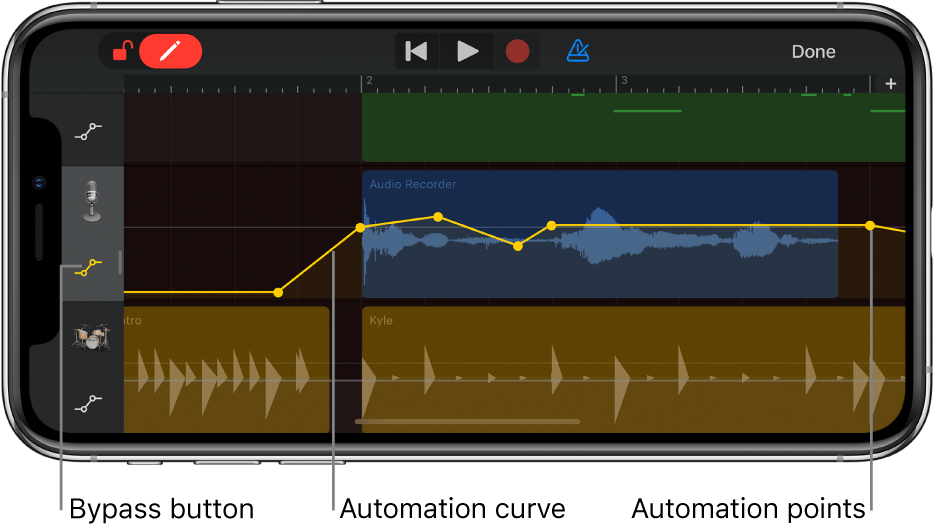
You can automate volume changes over time using automation curves. When you show track automation, each track’s automation curve shows the volume level over time. You can create volume changes by adding automation points, and dragging them to different values.
Open the automation editor
Tap a track header, then tap Automation.
The tracks expand vertically and a volume automation curve appears over each track.
Add automation points
Touch and hold the Edit Automation button on the left side of the control bar, tap a track automation curve, then drag vertically to adjust the value of the automation point.
You can also drag the Edit Automation button right to lock it.
Select automation points
Tap an automation point to select it.
To select multiple automation points, do one of the following:
Touch and hold an automation point, then tap others to add them to the selection.
Tap the automation curve between two automation points to select both of them.
Touch and hold an empty part of the track, then drag around automation points to select them.
Move automation points
Cut and paste automation points
You can cut and paste automation points to a different position on the same track, or to another track.
Select one or more automation points, tap one of them, then tap Cut.
Position the playhead at the point where you want to paste the first cut automation point.
Tap the track where you want to paste the cut automation points, then tap Paste.
Copy and paste automation points
You can copy and paste automation points to a different position on the same track, or to another track.
Select one or more automation points, tap one of them, then tap Copy.
Position the playhead at the point where you want to paste the first copied automation point.
Tap the track where you want to paste the copied automation points, then tap Paste.
Delete automation points
Touch and hold the Edit Automation button (or lock it), then tap an automation point to delete it.
To delete multiple automation points, select the automation points, tap one of them, then tap Delete.
Turn off automation for a track
You can turn off (or bypass) automation for a track so that the track sounds without the automation.
Tap the Bypass button in the lower-right corner of the track header. Tap the Bypass button again to turn on automation for the track again.
If the Bypass button is yellow, automation is on. If the Bypass button is white, automation is turned off. While automation for a track is turned off, you cannot edit automation points.
Close the automation editor
Tap Done in the upper-right corner of the control bar.
GarageBand User Guide for iPad
If you have Audio Unit Extensions or Inter-App Audio apps installed on your iPad, you can use them with GarageBand as instruments or effects.
You can buy Audio Unit Extensions or Inter-App Audio apps on the App Store or from third-party vendors.
Add an Audio Unit instrument
You can add Audio Unit instruments to your song and then play and record them as Touch Instruments, similar to the Keyboard. You can save, rename, and delete custom sounds for an Audio Unit instrument in the same way you do with sounds for a Touch Instrument.
In the Sound browser, swipe left or right until you see External, then tap Audio Unit Extensions.
Tap the instrument you want to add.
Tap Presets to load, save, and edit sounds.
If the Audio Unit instrument has its own preset sounds, the name of the sound appears instead of Preset.
Some Audio Unit instruments have their own custom view. If so, the custom view appears when you open the instrument. You can switch between the custom view and the standard view by tapping the Controls View button . If your iPad supports facial recognition, you can control the mod wheel of an Audio Unit instrument with Face Control.
Add an Audio Unit effect
How To Lower Volume In A Section In Garageband Ipad 5
You can use Audio Unit effects to change the sound of instruments, similar to plug-ins in the track controls.
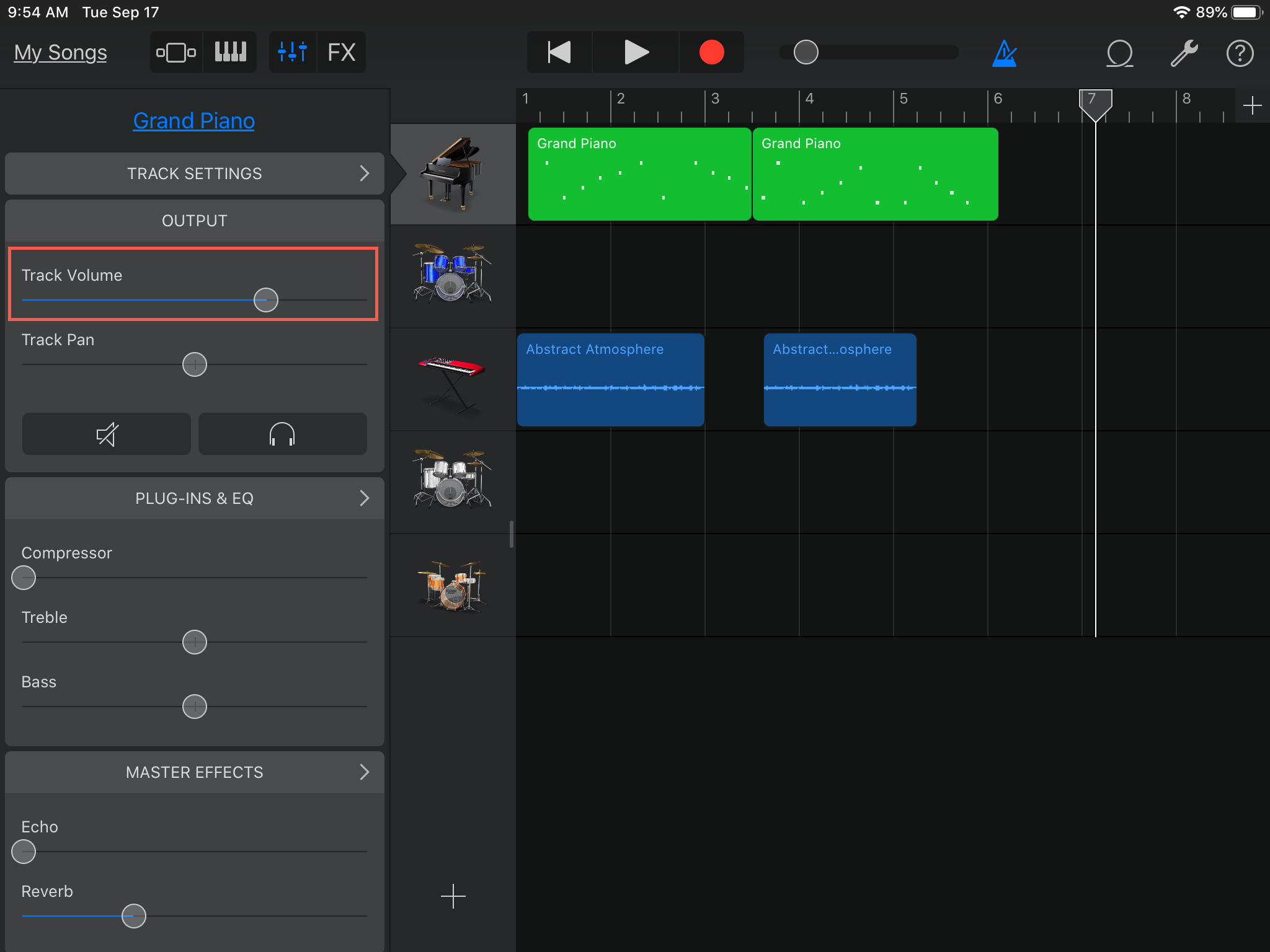
Tap the Track Controls button in the control bar, tap Plug-ins & EQ, then tap Edit.
Tap the Add Plug-in button on one of the empty plug-in slots or tap the name of the plug-in you want to replace.
Tap Audio Unit Extensions.
Tap an Audio Unit effect in the list.
The Audio Unit effect is added to the list of plug-ins.
Tap the Audio Unit effect in the list to view its settings.
Tap Presets at the lower-left of the plug-in window to save, rename, and delete your own custom presets.
If the Audio Unit effect has its own presets, its name appears instead of Preset.
Add an Inter-App Audio instrument
You can record the sound output of an Inter-App Audio instrument to an Audio Recorder, Amp, or Sampler track in your song.
Do one of the following:
In the Sound browser, tap External, tap Inter-App Audio, tap Instrument, then tap an app.
Sep 13, 2018 Learn how to use Music Rebalance in RX 7 for vocal source separation. Easily separate your favorite vocal lines in just a few clicks, so you can get back to the meat of your project, whether it. Apr 06, 2020 In Part 1 and Part 2 of this series, we discussed the basics of the Music Rebalance module in RX 7.We’ve covered all the interface elements and features, as well as some guidelines for achieving the most musical results. We’re getting weird for part three, as we deliberately abuse the capabilities of Music Rebalance to do things to audio that are difficult to accomplish in other ways—at. Izotope rx 7 standard. RX 7 Advanced. Designed specifically for the demanding needs of post production professionals, RX 7 Advanced continues to lead the audio post production industry with powerful restoration tools used in major film and television projects worldwide. Reduce some of the reverb from a recorded space with the De-reverb audio plug-in and module in iZotope RX 7. Salvage recordings of dialogue containing too much reverb/acoustic space without needing to spend time/money on a reshoot or ADR. Restore problematic vocal or production recordings in real time with iZotope RX's Voice De-noise audio plug-in and module. Improving on the earlier Dialogue De-noise, the zero-latency Voice De-noise is the most powerful de-noiser focused on dialogue and sung vocal treatment.
In an Audio Recorder, Amp, or Sampler Touch Instrument, tap the Input Settings button , tap Inter-App Audio, then choose an app from the Instrument submenu.
Add an Inter-App Audio effect
How To Lower Volume In A Section In Garageband Ipad 3
You can use an Inter-App Audio effect to modify the sound of an Audio Recorder, Amp, or Sampler Touch Instrument when you record it in GarageBand.
Virtual DJ Software, MP3 and Video mix software. VirtualDJ provides instant BPM beat matching, synchronized sampler, scratch, automatic seamless loops. Virtual dj pro free download. Aug 26, 2016 VirtualDJ is a software used by DJs to replace their turntables and CD players, and use digital music instead of vinyl and CDs. It lets you 'mix' your songs, by playing two or more tracks at the.
How To Lower Volume In A Section In Garageband Ipad 4
Do one of the following:
In the Sound browser, tap External, tap Inter-App Audio, tap Effect, then tap an app.
In an Audio Recorder, Amp, or Sampler Touch Instrument, tap the Input Settings button , tap Inter-App Audio, then choose an app from the Effect submenu.
Record a performance with an Inter-App Audio instrument
Some Inter-App Audio instrument apps provide support for controlling GarageBand. If the app supports such controls, you can play your GarageBand song, and record to it, from within the instrument app.
How To Lower Volume In A Section In Garageband Ipad 7
For instrument apps that do not provide support for controlling GarageBand, start recording in GarageBand, then switch to the instrument app to play your performance.
Before you start recording, you may want to set the song section length to Automatic, so the recording is not cut off before you finish the performance.
How To Lower Volume In A Section In Garageband Ipad 1
In GarageBand, tap the Record button to start recording.
Open the Inter-App Audio instrument app from the app switcher.
In the Inter-App Audio instrument app, play your performance.
When you finish playing, open GarageBand again from the app switcher.
In GarageBand, tap the Stop button to stop recording.
How To Lower Volume In A Section In Garageband Ipad 7
You can record from other music apps to GarageBand using the Audiobus app if it is installed on your iPad.